In preparation for a very special Biodanza weekend in Philadelphia with lineage holder Carolina Churba from Argentina, Len Lear of The Chestnut Hill Local and I had an extended conversation about my background and journey, the Dance of Life, and its growing roots in the birthplace of the United States at a pivotal moment. A shorter piece was published in the paper the week of 2/19/2026. Here is the unabridged interview.
Where did you grow up?
I grew up in the suburbs of Philadelphia, in Haddonfield, New Jersey. Minus a brief time away in college, and, more recently, a 2.5 year sojourn to Providence, RI (to complete my Biodanza training), I have lived in the Philadelphia area for most of my life.
Where did you go to high school?
I went to high school just outside of Philly at Moorestown Friends School (in Moorestown, NJ). I’m a product of a lifetime of Quaker education which has always felt very “Philly” given our city’s founder!
What was your schooling after high school?
After high school I went to Goucher College, a small, private liberal arts school in Maryland, where I majored in English and minored in Spanish. I graduated in 1999 with a BA.
Following my time at Goucher, I returned to Philadelphia to study Education at the University of Pennsylvania’s Graduate School of Education (GSE). I received my M.S.Ed. (Masters in Education) in 2001 from UPenn.
After my time at Penn, I taught high school English for 6 years before going back to school to study Counseling Psychology at Temple University.
I graduated with a second Masters, this time in Counseling Psychology, in 2009 from Temple.
Where do you live now? For how many years?
I recently moved back to Philadelphia (which I consider to be home) in September of 2025. Prior to that, I had been living in Providence, RI for the previous 2.5 years, immersing myself in my Biodanza training before becoming certified in the modality last summer.
How do clients generally find out about your psychotherapy and wellness practice?
People find me in various ways, from the mundane to the magical. On the former end, it is often Google searches, my Psychology Today listing, and word of mouth referrals from myriad people—other practitioners, clients, former clients etc.
On the latter end, it is through what Carl Jung would have called synchronicities—uncanny coincidences that seem almost unreal (but aren’t). I have many stories of these sorts of occurrences over the years. These fortuitous meetings have led to some of the most meaningful connections in my work. Sometimes I joke that Spirit does my “marketing” in some other dimension because many of these stories defy basic logic and/or algorithmic calculus!
What are the most common issues that clients come to you for?
People come to me for a range of existential issues that are not necessarily unique to therapy—relationship concerns, questions related to sexuality, life transitions, health struggles, crises of meaning and purpose, generalized anxiety, depression, and chronic stress.
What sets me apart is less one particular area of expertise (say ADHD or PTSD) and more my particular approach—the greater context with which I hold what wants to be explored. I have a very psycho-spiritual lens that also includes the somatic body. I have never resonated with more hyper-clinical models of therapy. We are complex and multi-faceted beings that cannot be put into neat boxes. We are also so much more than our trauma. What draws people to me again and again is a deep resonance with my more soulful, artistic sensibilities and the reverence that I pay to what is unapologetically alive and determined to prevail.
How long do clients generally come to you?
It depends. Sometimes for several months. Sometimes for several years. Sometimes people return at a later point in life when they find themselves at a different crossroads. That is always a high compliment because, clearly, our prior work was meaningful.
Do you do group work as well as individual sessions?
I do individual sessions, couples sessions, and family sessions. I also facilitate groups and group processes in myriad forms. Most recently, my group facilitation has been focused on Biodanza sessions (a somatic, relational movement modality from South America). I have also facilitated work under the umbrella of Authentic Relating Practices over the years, including a particular relational meditation practice called Circling.
To be clear, Authentic Relating, Circling, and Biodanza are not under the clinical hood of “therapy.” While they are often quite therapeutic, their intent is not to diagnose or heal; instead, they work to unfold aliveness, following emergent glimmers of generative affect, thereby carving out a path toward greater flourishing.
What exactly is a somatic therapist?
Somatic psychotherapy concerns itself with how the body archives experience. We might say that “the body remembers,” as it becomes a kind of storehouse for the unconscious. As a somatic therapist, I help people tune into and listen to the body’s subtler language—that of breath, tension, sensation—as a way of accessing the invaluable wisdom that lies therein.
To paraphrase Einstein, we cannot solve a problem at the same level of consciousness that created it. Too often people spin in overplayed stories of what they think they know based on the logic of the mind. But the mind is not necessarily going to get us out of a rut that it generated. And so we have to look elsewhere. If we’re unable to leave the proverbial map (mind) for the immediacy of the territory (body), we risk foreclose on the pathway to discovery via a different route. Our somatic experiences offer a different route.
So as for what I do, I am a guide in this sometimes off-the-map terrain. A former client used to call me a “Somatic Sherpa.” Instead of leading people through the ruggedness of the Himalayas, I shepherd them through their own inner wilderness.
How and when did you become interested in Biodanza?
Almost a decade ago I was at a dinner party at a friend’s house in Philadelphia. Over hors d’oeuvres, I began talking with a woman who had just moved back to the States after living in South America. She asked me about my work and I shared that I was a somatic psychotherapist who also taught authentic relational practice and had a background in yoga and movement. When she heard the synthesis of modalities in my repertoire and listened to my integration of them, she said, “You would love this dance practice that I did every week while living in Chile.” She then proceeded to describe Biodanza in an exquisitely compelling way. Suffice it to say, I was moved by the idea of a more organic, somatic, relational dance, set to bodies, music, and the poetics of embodied encounter.
That night I went home and initiated a Google search. I was already hungry to experience this process. What became evident very quickly was that there was very little Biodanza happening in the United States; the closest option looked to be several hours away in Maryland. Despite the website saying that a school was coming, there were no easy opportunities; classes looked to be sporadic. The ones that did pop up were offered on weeknights. I couldn’t travel that kind of distance mid-work week. Finally, two years after I commenced my search, the facilitator advertised a weekend workshop. I promptly booked a trip.
What is it about Biodanza that you find so appealing?
Biodanza compelled me in theory first, as noted above. Despite the fact that I find it nearly impossible to explain to people exactly what it is (you just have to do it!), I resonated with its fundamental aim. For context purposes, it would probably be helpful to provide a basic description.
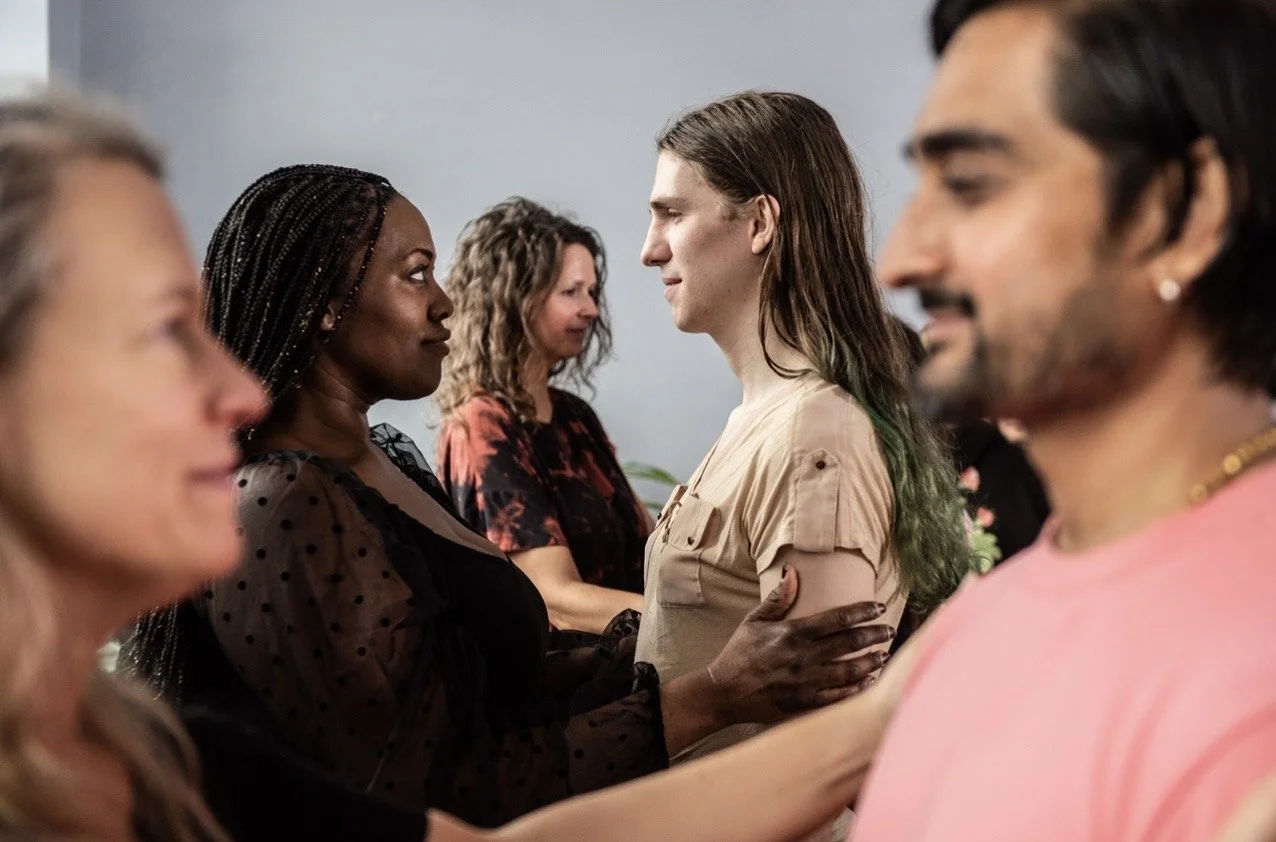
The word “Biodanza” literally translates, from Spanish, to mean “The Dance of Life.” Founded in the 1960s by Chilean anthropologist and psychologist Rolando Toro, it is an elegant system of somatic and relational self-development that combines dance, music, archetypal gesture, and intentional connection to stimulate five lines of human potential: vitality, sexuality, creativity, affectivity, and transcendence. It fosters reconnection with our vital instincts, our emotions, our bodies, and our in-the-flesh relationship with each other as dynamic, feeling human beings. Sometimes referred to as “The Poetry of Human Encounter,” it is truly a Masterclass in embodied Love.
I knew, immediately upon experiencing it, that Biodanza was a modality that I wanted to study and immerse in. It transmitted something viscerally alive and indispensable about human connection. And it paid homage to the majesty of the heart in a way that was noble without being saccharine. It also provided permission for people to love more unabashedly, in an embodied way that was in keeping with the natural proclivities of our limbic systems. It just made sense—yes, in my mind, but, more importantly, in my body.
Additionally, one of the most profound aspects of Biodanza lies in its power to be a bridge between the archetypal world and the phenomenal world—to evoke core human themes in such seemingly simplistic, but exquisitely-felt rituals. It’s uncanny how the most basic dance or encounter can take me right to the heart of something about my existential condition in a way that is moving and evocative.
I’m also a lover of aesthetics. Beauty is not static and it’s not superfluous—it is a dynamic way of creating possibility in a forlorn world. And it can be used as a potent force for change. Rolando Toro understood this, which is evident in everything about Biodanza from the music to the poetic gestures to the gazes and the embraces.
In addition, I find it deeply compelling that Biodanza was created as a response to the horrors of World War II. It was born out of political chaos and what Toro described as “a civilization of death.” And so he conceived of it as a pedagogy of life—as “a re-education in love.” If this isn’t poignantly apropos given the state of our contemporary world, I don’t know what is.
The fact that this modality has been slow to infiltrate the United States also feels significant. There’s an old adage in the psychotherapy world that often the patient resists the medicine that is needed most. We are absolutely starving for the precise nutrients of Biodanza in America right now. And it’s not lost on me that Philadelphia, the birthplace of our nation, is calling it in.
How did the Feb. 27-March 1 event come about?
Biodanza in this city has been an evolving endeavor. The groundwork started even before I officially moved back. I knew building a community in Philly was my next project. And so I started planting seeds during visits home to see family. I talked about it incessantly, connected and re-connected with folks here, and generated a significant amount of interest.
In late spring of last year, I had the idea to ask Meghan (Dwyer), my longtime friend who had some Biodanza experience, if she wanted to co-host an inaugural outdoor vivencia on her family’s land in Chestnut Hill when I returned in September. She was thrilled with the idea and we ran with it.
Neither one of us ever expected that on the Wednesday night of back-to-school week, we would get a crowd of almost 40 dancers. But, alas, we did. Since then, I have been holding open dances, usually on Friday evenings, once or twice a month at Cocoon, a lovely yoga studio inside the Circus Arts School in Mt. Airy. Most of those dances have sold out.
I have also run two Series where we deepen the practice, over six weeks, in a closed group. So I’ve been offering both “tastes” of it and more committed structures. Jacob Ellis, the owner over at Cocoon, has been terrific to work with, and I’m so grateful for his support in bringing the Dance of Life to the Northwest corner of our city.
Philly has responded to Biodanza in a rather unprecedented way. I have seen it take years to get even a handful of dancers for a regular class in other places. And even some of my friends who teach different dance modalities here have been wowed by the immediate numbers. This isn’t typical.
So, basically, I’m running with the momentum. I’m responding to a call to grow this amazing practice, to provide more opportunities to immerse in the dance and to learn. My teacher, Carolina Churba, is a direct lineage holder who met Rolando Toro in Buenos Aires when she was just 18. She has been a leading figure in exporting this modality from South America to the rest of the world.
Carolina is a wild force of creativity and she follows the energy of the dance unapologetically. She just goes where it wants to be. I’ve never met a teacher whose loyalty to her mission is so clear and relentless. I mean that with the highest praise. We share a language that way. So this next step of having her come to Philly just seemed obvious.
This city has a spiritedness and a feistiness that isn’t for the faint of heart. That’s part of what I love about Philly—it’s real, no-nonsense, sometimes gritty, and full of character. Carolina’s energy will gel with the vibe here.
One of the things that I think some Biodanza teachers miss is that it’s important to have a pulse on the heartbeat of a place—there is a time to stay stringent with the orthodoxy of a practice and a time to know when and how to innovate given the culture one is walking into. Because I’ve lived in Philadelphia for so much of my life, I have an intimate sense of this city’s personality. It will eject what doesn’t work. That’s just the way Philly rolls! Carolina has developed a particular skill in bringing this practice to cultures very different from the one that birthed it. She knows how to remain loyal to what is vital and also how to pioneer as necessary. We share this sensibility which is, in part, what feels synergistic about our connection.
So she will be here leading an incredible weekend of Biodanza in an effort to keep growing the Philly community. I encourage anyone who is curious to take a chance and join us. The immersion is open to everyone, regardless of experience level. We need community more than ever right now, which is at the heart of this practice. We’ll dance together, eat together, have a siesta together. I hope that people will come out and bring whatever they’re carrying—their tenderness, their love, their joy, their grief…it’s all welcome in our circle. The dance is potent medicine. As the great Alice Walker once wrote, “Hard Times Require Furious Dancing.”
How many people do you expect to come?
I imagine the Friday night vivencia could be quite large. The full weekend immersion is a different level of commitment. It’s a closed container that’s designed for deepening with the group. It’s hard to predict how many people will come. What I can tell you is that we have my teacher Carolina and another facilitator coming from South America. We have an experienced Biodancera coming from Mexico. We have a bunch of facilitators and friends from the RI School coming. And we have several devoted dancers coming from the Baltimore/Washington area. Suffice it to say, the event is drawing people from far and wide.
What is the best decision you ever made in your life?
To do the Biodanza Training with my teacher Carolina and my cohort from the Rhode Island School. It fundamentally changed my life, provided a stamp of undeniable certainty on my mission, and taught me more about Love than anything else I’ve ever done.
What is the best advice you have ever received?
My dear friend Gabriel (who I met in my somatic psychotherapy training and who was my initial connection to the RI Biodanza School) used to say to me as a refrain, “Go where you’re loved.” I have thought about that so many times over the years. I used to spend far too much energy and effort contorting myself, jockeying for a position, or dimming my light to fit into groups, circumstances, and/or relationships that ultimately weren’t a fit. Sometimes love can just be simple. It doesn’t have to be a fight.
Suffice it to say, that advice called me to RI, and then it called me back home to Philly. I have family here, beloveds, dear friends, clients, and a budding community of dancers that I’m fervently tending and loving as we grow.
What is the hardest thing you ever had to do?
I’m a great lover of paradox, so it is fitting that the hardest thing I’ve ever done has been synonymous with the best thing I’ve ever done. I left “home” at midlife, on my own terms for the first time, leaving behind family and a sense of anchored security to set sail on a quest of discovery. Soulful endeavors always have a call that is incontrovertible and non-negotiable. We abide them in spite of logic or good sense. Following the force of Biodanza to RI was both glorious and brutal. It had all of the ingredients of an epic—there were proverbial monsters, sirens, sorcerers, and sometimes highly unfavorable winds.
Over the course of the last couple of years, I have indeed lived some mythic themes. Not long after I got to RI, a friend and beloved member of our Biodanza community was brutally murdered. I fell in love in a way that fundamentally rearranged my heart and then ultimately shattered it into a thousand pieces. I developed a chronic physical condition that I’m still reckoning with and learning from. Those were some of the devastations from the lowlight reel.
If you could meet and spend time with anyone on earth, living or dead, who would it be and why?
I cannot possibly narrow it down to one. Let’s start with the living. It’s a tie between Natalie Merchant and Esther Perel. My secret wish is that both of these woman will show up and dance Biodanza with me one day—I think they’d love it!
I’ve been a huge Natalie Merchant fan since I was 14. I knew, the first time I heard her voice—that unmistakable velvety alto—that she transmitted something rare and precious. To me, she is the epitome of a woman in her integrity. She just exudes devotion—whether it be to her art or to humanity. I’ve been to countless concerts of hers over the years and each time I watch her perform I am struck by how she occurs as an embodied prayer. Her authenticity of heart is felt. If I had to name a human who exudes the raw energy of Biodanza, it would be Natalie without a doubt.
Esther Perel is endlessly brilliant, fascinating, and beautifully curious about the vicissitudes of being human. She has a reverence for complexity and rigor, and also a great sense of play. I became enamored of her genius when her first book, Mating in Captivity, came out in 2006. Back then I would scour the internet for interviews and videos of her and there were only about 5 total! I wondered when the rest of the world would catch on. Now that she’s gone viral, I cannot even keep up with all of the media. You could say I was an “early adopter,” I guess! Anyway, she’s been a great source of personal and professional inspiration for me.
And as for the dead, I’d love to resurrect Toni Morrison, writer extraordinaire and queen of eloquence. I was just re-watching an old interview with her in which she was talking about the grandeur of life, and that, at the end of the day, it’s about being as fearless as possible and behaving as beautifully as possible under completely impossible circumstances. This, too, epitomizes an ethos that feels very Biodanza-esque to me. Not to mention that it is quite prescient wisdom for the times we’re living in.
